Affiliate marketing has always involved more than finding a product and sharing a link.
Behind a successful affiliate campaign are several separate tasks: researching offers, understanding the target audience, creating content, building pre-sell experiences, attracting traffic, following up with prospects, tracking clicks and conversions, and deciding what deserves more attention.
In 2026, artificial intelligence is changing many of these tasks.
But that does not mean AI has turned affiliate marketing into an automatic income system.
The more realistic change is that specialized AI tools can now assist with individual parts of the affiliate workflow — sometimes helping one person accomplish work that previously required several different tools or considerably more manual effort.
This guide explains where AI is actually being used in affiliate marketing, which parts of the process still require human judgment, and what to consider before adding another AI platform to your marketing stack.
What Are AI Affiliate Marketing Tools?
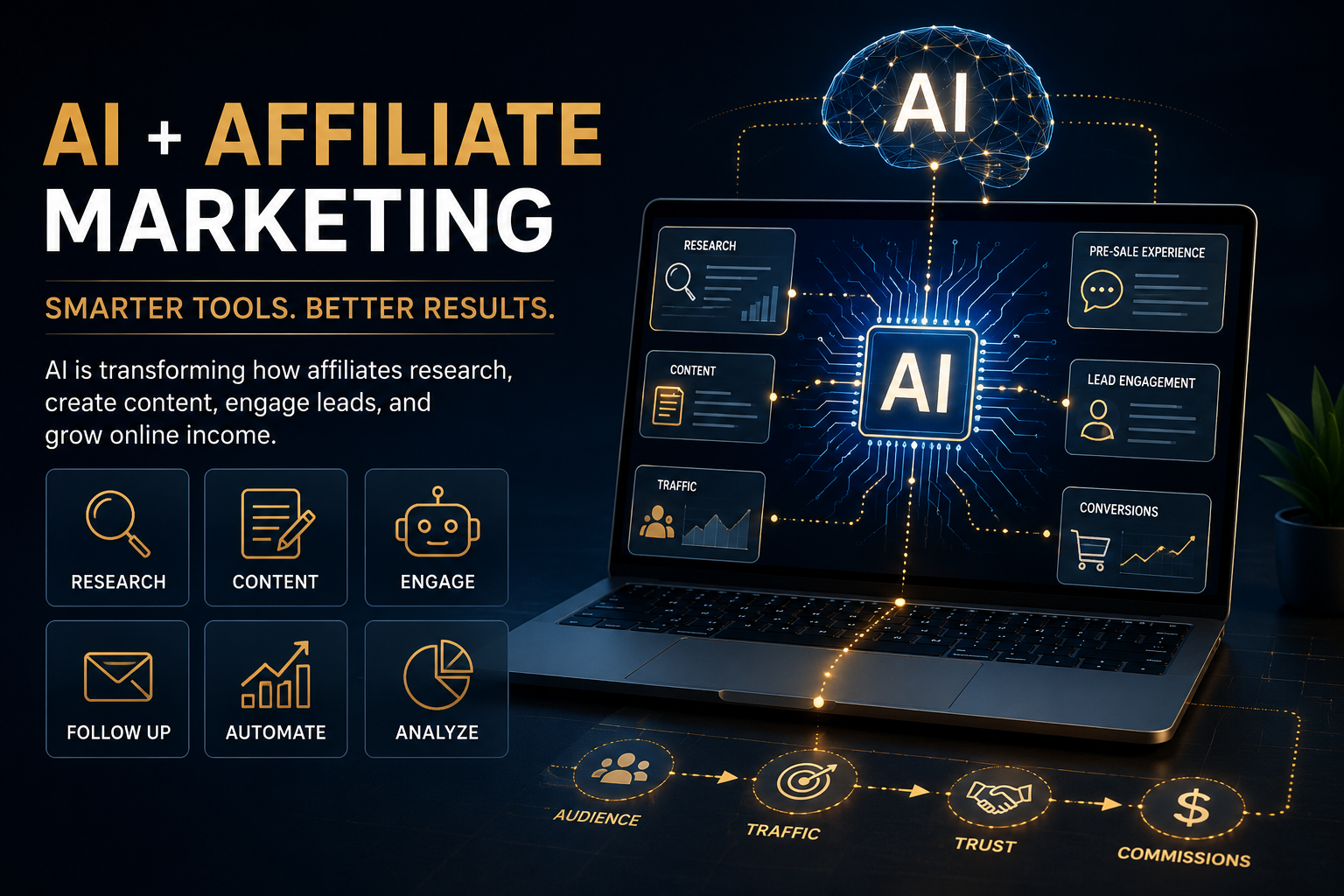
AI affiliate marketing tools are software platforms that use artificial intelligence to assist with one or more activities involved in promoting third-party products or services.
Depending on the platform, that can include:
- researching products and audiences;
- finding content opportunities;
- drafting articles and marketing copy;
- creating images or videos;
- building pre-sell or bridge pages;
- interacting with leads through AI chat or voice;
- creating email or follow-up sequences;
- analyzing campaign information;
- repurposing existing content;
- automating repetitive marketing tasks.
The important distinction is that these tools do not all solve the same problem.
A content-generation platform and an AI conversational agent may both be described as "AI marketing tools," but they operate at completely different stages of the affiliate funnel.
That is why evaluating AI tools by function is usually more useful than simply asking which AI affiliate tool is "best."
How AI Is Changing Affiliate Marketing
The biggest shift is not that AI replaces the affiliate marketer.
It is that more stages of the marketing process can now be assisted by software.
A traditional workflow might look something like this:
Offer → Research → Content → Traffic → Click → Sales Page → Conversion
Newer AI-assisted workflows can be considerably more complex:
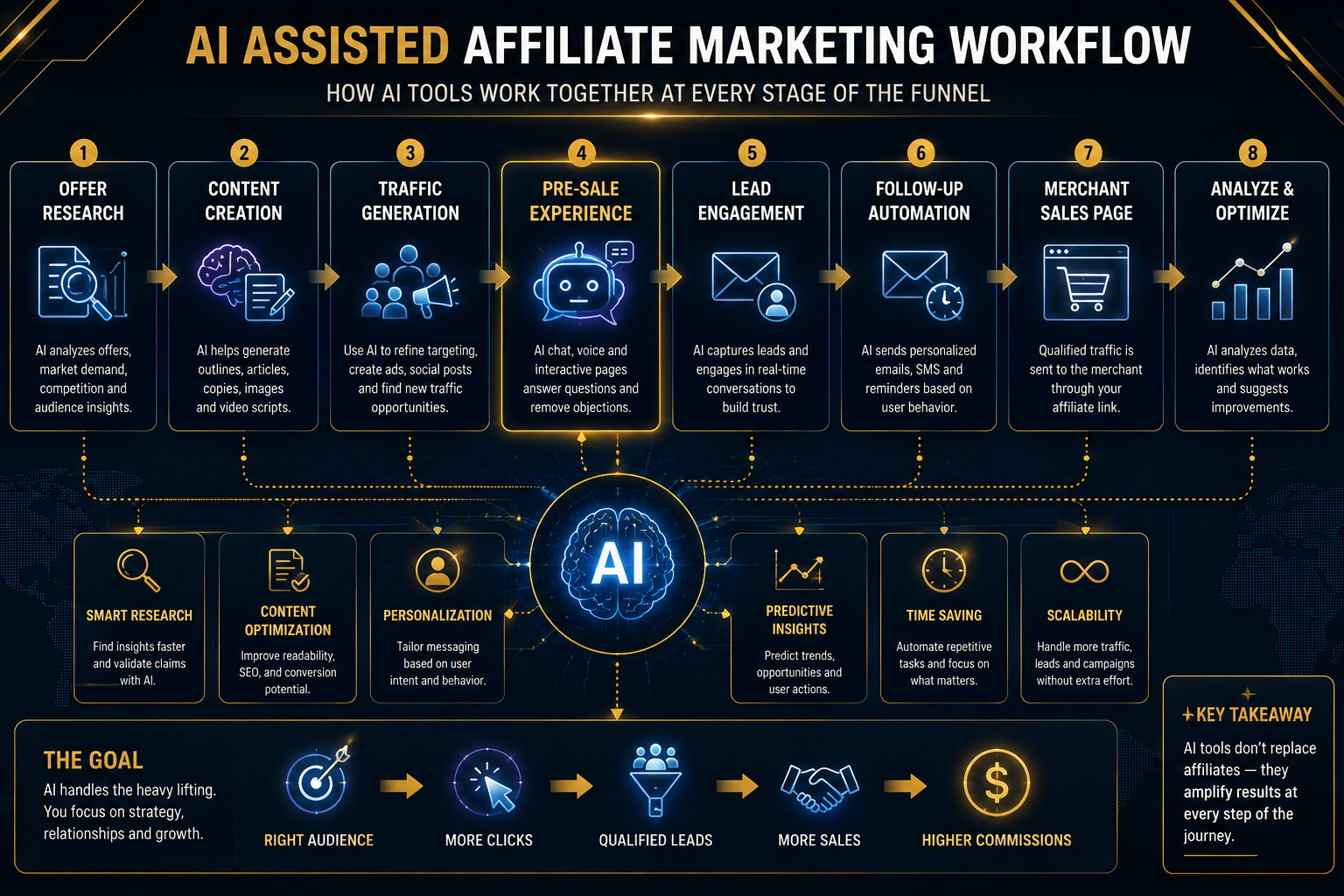
Offer → AI Research → Content → Traffic → Pre-Sell Experience → AI Interaction → Follow-Up → Merchant → Conversion Analysis
Not every affiliate needs that entire system.
For a review website, for example, search intent and high-quality editorial content may matter much more than conversational automation.
Someone generating leads for expensive services may place much greater value on AI-powered follow-up.
The right technology therefore depends on the bottleneck in the business.
1. AI for Offer and Audience Research
One of the first applications of AI in affiliate marketing happens before content is created.
An affiliate evaluating a new product needs to understand questions such as:
- What problem does the product solve?
- Who is likely to buy it?
- What objections might potential customers have?
- How does it compare with alternatives?
- Which features actually matter?
- What claims come from the vendor, and which can be independently verified?
AI can help organize this information much faster.
For example, an AI research workflow can take product documentation, sales-page information and other available sources and organize them into categories such as features, pricing, audience, limitations and common objections.
But there is an important limitation.
AI-generated research is not automatically verified research.
If an AI system summarizes an exaggerated vendor claim, the claim does not become more reliable simply because an AI repeated it.
For affiliate review sites, source verification remains essential.
2. AI for Affiliate Content Creation
Content generation remains one of the most visible uses of AI.
Modern tools can assist with:
- article outlines;
- headline variations;
- FAQ ideas;
- meta descriptions;
- social posts;
- email copy;
- video scripts;
- product summaries;
- comparison structures.
The advantage is obvious: AI can dramatically reduce the time required to move from research to a first draft.
The danger is equally important.
Publishing large quantities of generic AI-generated articles is not a sustainable SEO strategy.
Google's current guidance says generative AI can be useful for research and structuring original content, while generating many pages without adding user value can violate its scaled-content-abuse policies.
For affiliate publishers, this makes editorial judgment more important, not less.
AI can help create the draft.
The publisher still needs to determine whether the page deserves to exist.
3. AI for SEO and Search Intent
Affiliate SEO has traditionally relied on keyword research tools, competitor analysis and manual SERP evaluation.
AI adds another layer.
It can help identify relationships between topics, group keywords by intent, discover missing subtopics and organize content into clusters.
For an affiliate site, this can be particularly useful when separating different stages of the buyer journey.
Consider searches such as:
"What is AI affiliate marketing?"
and:
"Agentic Affiliate review"
Both relate to AI and affiliate marketing, but their intent is very different.
The first user is researching a concept.
The second is investigating a particular product and may be much closer to making a purchasing decision.
Treating both queries as though they were interchangeable can create weak content and even internal competition between pages.
A better approach is to use informational articles to support — rather than duplicate — commercial review pages.
That is also why this guide focuses on the broader AI affiliate marketing tools topic rather than attempting to reproduce our individual product reviews.
4. AI for Pre-Sell and Bridge Pages
One of the more interesting developments in affiliate software is the evolution of the traditional bridge page.
A basic bridge page sits between the affiliate's traffic source and the merchant's sales page.
Its job might be to introduce the offer, explain its benefits or prepare visitors before sending them to the vendor.
AI can make that experience more dynamic.
Instead of showing every visitor exactly the same static page, newer platforms can potentially use conversational interfaces to answer questions, surface relevant information and respond to objections before sending the prospect further into the funnel.
This is where platforms such as Agentic Affiliate represent a different category from ordinary AI writing software.
According to the vendor, Agentic Affiliate can analyze an offer and create a hosted Bridge experience that combines browser voice, browser chat, phone and SMS interaction.
That does not mean the software guarantees higher conversions or affiliate income.
It means conversational AI is being introduced into a part of the affiliate funnel that historically consisted mostly of static pages.
For a detailed examination of its features, pricing, Front-End limitations and upgrades, read our Agentic Affiliate Review 2026.
5. Conversational AI and Affiliate Marketing
Conversational AI deserves its own category because it changes the way a visitor interacts with a campaign.
A traditional affiliate page communicates in one direction.
The publisher presents information.
The visitor reads it.
A conversational system potentially creates a two-way interaction.
The visitor can ask something.
The system can respond.
This can happen through chat, browser-based voice or, depending on the platform and configuration, external communication channels.
For certain affiliate models, this could be particularly useful when the purchase requires more explanation.
However, conversational AI also introduces additional considerations.
Affiliates need to think about accuracy, privacy, disclosure, operating costs, platform limitations and what happens when the AI cannot answer a question correctly.
Adding AI conversation to a funnel only makes sense when the interaction provides genuine value to the visitor.
6. AI for Follow-Up
Not everyone who clicks an affiliate campaign is ready to buy immediately.
That makes follow-up another area where automation can be useful.
Depending on the platform, AI-assisted follow-up may help with:
- segmenting leads;
- drafting personalized messages;
- adjusting communication based on previous interactions;
- summarizing conversations;
- identifying common objections;
- scheduling subsequent contact.
This can reduce repetitive manual work.
But affiliates should distinguish between automation and persuasion.
Software can send or help create a follow-up message.
It cannot guarantee that the recipient will open it, trust it or purchase anything.
7. AI for Content Repurposing and Distribution
Creating good content is only part of the problem.
Distribution takes time as well.
A detailed review might potentially become:
- a short social post;
- a video script;
- a YouTube Short concept;
- an email;
- several promotional angles;
- supporting informational content.
AI tools can accelerate this repurposing process.
This is where a platform such as ContentClaw fits into a different part of the AI marketing ecosystem than Agentic Affiliate.
Agentic Affiliate focuses more heavily on the pre-sell/conversation/follow-up side of the funnel, while ContentClaw is positioned around content creation and distribution.
If that part of the workflow is more relevant to you, see our full ContentClaw Review.
This distinction matters because buying multiple AI platforms that solve essentially the same problem can quickly create unnecessary software costs.
8. AI for Campaign Analysis
Affiliate marketers can collect a surprising amount of information.
Clicks, traffic sources, landing pages, conversion rates and other campaign metrics can quickly become difficult to interpret manually.
AI can assist by organizing information and identifying patterns that deserve investigation.
But analysis requires context.
A page receiving more clicks is not necessarily more profitable.
A campaign with a high conversion rate may be based on a very small sample.
And an AI-generated recommendation is still a recommendation — not proof.
The underlying data remains more important than the sophistication of the analysis interface.
Where AI Still Cannot Replace the Affiliate Marketer
The rapid growth of AI marketing software can create the impression that the entire affiliate business can now run autonomously.
That is misleading.
Several important responsibilities still require human judgment.
Choosing what deserves promotion
A tool can analyze an offer.
It cannot decide what your audience should trust without human oversight.
Verifying claims
Vendor sales pages frequently contain promotional claims.
Affiliates still need to distinguish marketing statements from independently verified facts.
Understanding search intent
AI can suggest keywords and topics, but editorial strategy requires understanding why a page should exist and what the visitor actually needs.
Building trust
Trust comes from accuracy, transparency and consistently useful information.
Automation cannot manufacture credibility.
Making business decisions
AI can provide data.
The affiliate remains responsible for deciding whether the data justifies spending more time or money on a campaign.
AI Automation Does Not Mean Passive Income
This deserves particular emphasis.
An "automated" affiliate system is not the same thing as an automatic-income system.
AI can automate tasks.
It cannot guarantee:
- traffic;
- rankings;
- clicks;
- leads;
- conversions;
- commissions;
- profitability.
A sophisticated funnel with no qualified traffic can still produce nothing.
Excellent traffic sent to a poor offer can still perform badly.
And even a strong campaign can change when competition, search behavior, vendor pricing or market conditions change.
AI reduces certain kinds of work.
It does not remove business risk.
How to Choose an AI Affiliate Marketing Tool
Instead of asking which platform has the longest feature list, start with the problem you are trying to solve.
If your problem is content production
Look for tools that improve research, drafting, editing or repurposing.
If your problem is SEO
Focus on search intent, competitive research, content gaps and optimization rather than raw article generation.
If your problem is lead engagement
Conversational AI, chat and follow-up systems may deserve more attention.
If your problem is distribution
Look for platforms that can turn existing assets into content suitable for multiple channels.
If your problem is tracking
Prioritize reliable measurement and attribution before adding more automation.
If you do not know what your problem is
Do not buy another tool yet.
Software should solve a bottleneck, not create another subscription.
Questions to Ask Before Buying an AI Marketing Platform
Before purchasing any AI affiliate tool, investigate:
What exactly does the Front-End include?
A low advertised entry price may not include every feature shown across the broader funnel.
Are there usage limits?
Look for limits on campaigns, leads, generations, contacts, integrations or storage.
Are external services required?
Some functionality may require third-party APIs or accounts.
Are there recurring costs?
"One-time payment" may describe the core software while external services or optional upgrades remain recurring.
Which features are upgrades?
Separate Front-End functionality from OTOs, bundles and premium plans.
Does the tool solve a current problem?
This may be the most important question of all.
A feature is not valuable simply because it exists.
AI Affiliate Tools Are Becoming More Specialized
One noticeable development in 2026 is specialization.
The category is moving beyond generic "AI writer" products.
Tools now target specific parts of the workflow: SEO research, creative production, content distribution, conversational engagement, tracking, follow-up and campaign automation. Current 2026 industry coverage similarly describes AI use across multiple stages rather than as a single universal affiliate tool.
That means the future affiliate technology stack may not revolve around finding one platform that "does everything."
It may instead involve combining a small number of specialized tools around a clear workflow.
The key word is small.
More automation is not automatically better.
What This Means for Affiliate Review Sites
For review publishers in particular, AI creates both an opportunity and a risk.
The opportunity is efficiency.
Research can be organized faster. Content structures can be developed faster. Large amounts of product documentation can be summarized. Internal linking opportunities can be identified. Supporting content can be planned more systematically.
The risk is sameness.
If hundreds of affiliate sites use AI to summarize the same sales page, they can end up publishing essentially the same information in slightly different words.
That provides very little reason for a reader — or a search engine — to prefer one page over another.
Google specifically identifies affiliate pages that simply reproduce merchant information without meaningful added value as problematic, while recognizing that good affiliate sites can add value through useful additional information, original evaluations, rigorous comparisons and better product/category navigation.
That distinction is increasingly important.
Final Thoughts
AI is changing affiliate marketing, but probably not in the way the most aggressive marketing claims suggest.
The meaningful change is not a button that automatically creates commissions.
It is the gradual introduction of AI into individual parts of the workflow:
Research. Content. SEO. Pre-selling. Conversation. Follow-up. Distribution. Analysis.
Different tools address different stages.
For publishers, the challenge is determining which of those stages actually needs improvement.
If your bottleneck is content distribution, a platform focused on content workflows may make sense.
If your bottleneck is engaging prospects between the initial click and the merchant offer, conversational platforms represent a newer approach worth understanding.
And if you are specifically evaluating that second category, our detailed Agentic Affiliate Review examines what the $37 Front-End includes, its limitations, the upgrade structure, pros, cons and who the platform is actually designed for.
Ultimately, AI should make an affiliate operation more useful and efficient, not simply more automated.
The fundamentals remain surprisingly familiar:
Understand the audience.
Choose offers carefully.
Create genuinely useful content.
Measure what happens.
And never confuse automation with guaranteed results.