Artificial intelligence is changing the way traders research markets, analyze data, and identify potential opportunities. But one important distinction often gets lost in the conversation: using AI to help make a trading decision is not necessarily the same thing as allowing software to trade automatically.
AI-assisted trading tools and automated trading bots can both use technology to process market information, but the role of the trader can be very different.
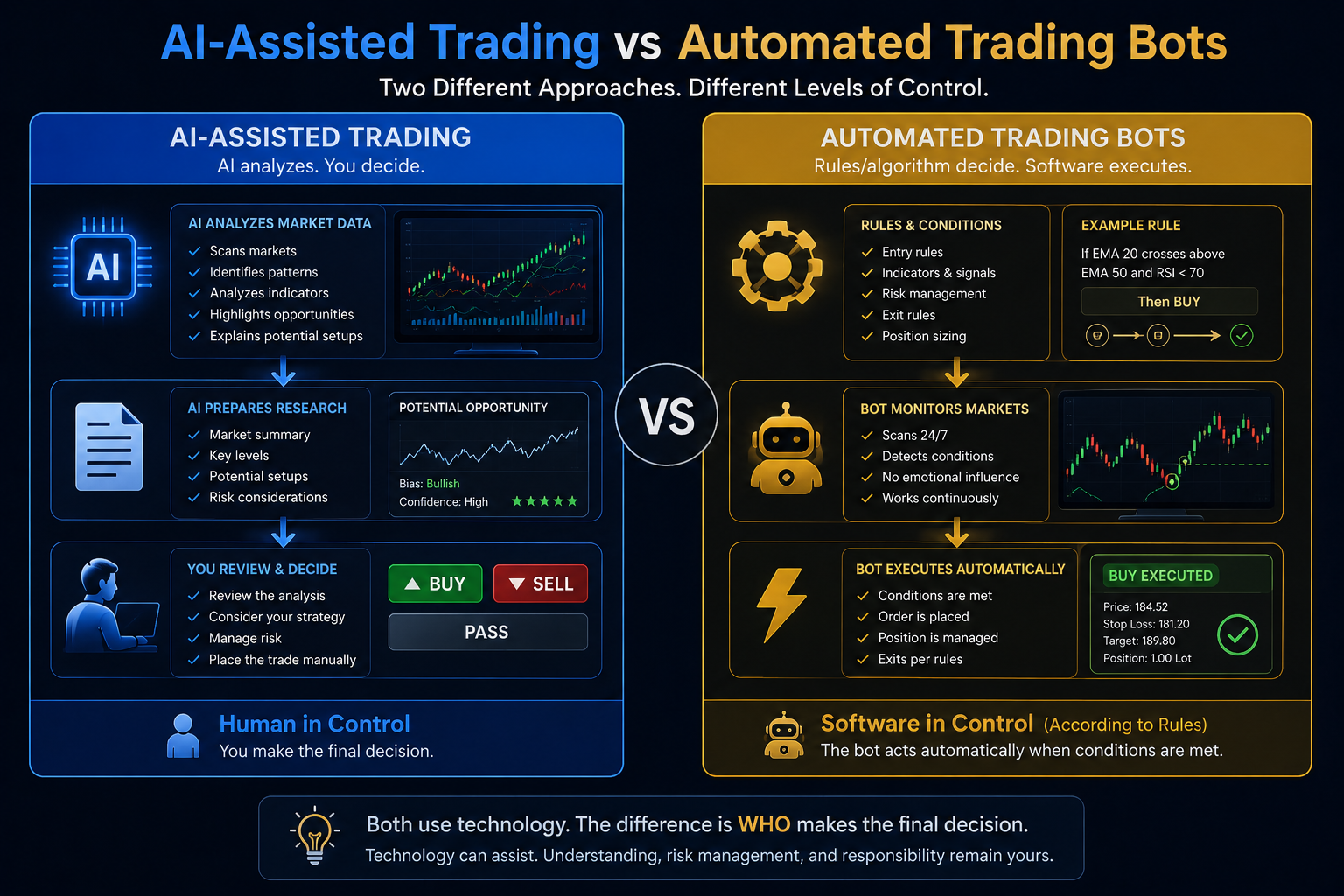
With an AI-assisted approach, software may analyze charts, identify patterns, organize market data, or prepare potential setups while leaving the final decision to the user.
An automated trading bot, on the other hand, may be configured to execute trades when predefined conditions are met, sometimes without requiring the trader to approve each individual transaction.
That difference affects control, automation, risk management, and the skills required from the user.
In this guide, we'll break down how these approaches differ, where they overlap, and what traders should understand before relying on either one. You can find more of our coverage of AI tools in our dedicated hub.
What Is AI-Assisted Trading?
AI-assisted trading uses artificial intelligence or related data-processing technology to help a person analyze financial markets and make decisions.
Depending on the software, an AI-assisted system might:
- Analyze market data
- Scan multiple assets
- Identify patterns or setups
- Summarize technical information
- Highlight potential opportunities
- Organize research
- Generate alerts
- Explain why a particular setup may deserve attention
The important point is that AI assistance does not automatically mean trade execution.
Some systems are designed primarily as research and decision-support tools. They can reduce the amount of information a trader has to process manually while still leaving the final buy, sell, or no-trade decision in human hands.
The technology helps with analysis, but the trader remains responsible for the final decision.
What Is an Automated Trading Bot?
An automated trading bot is software designed to follow trading rules and, in many cases, execute orders automatically.
A bot may monitor markets continuously and respond when predefined conditions are triggered.
For example, a system could theoretically be configured around conditions involving:
- Price movements
- Technical indicators
- Volatility
- Volume
- Trend conditions
- Entry rules
- Exit rules
- Stop-loss levels
- Position sizing
When the required conditions are met, an automated system may submit an order without waiting for manual confirmation.
The exact level of automation varies considerably between platforms.
Some systems automate only certain parts of the process, while others can handle entries, exits, and other trade-management actions.
AI Trading and Automated Trading Are Not the Same Thing
The terms are sometimes used interchangeably, but they describe different concepts.
Artificial intelligence refers broadly to technologies capable of processing information, identifying patterns, generating analysis, or performing tasks that traditionally required human judgment.
Automation refers to performing an action automatically according to predefined rules or triggers.
A trading system can therefore be:
- AI-assisted but not automated
- Automated but not AI-powered
- Both AI-powered and automated
- Neither
For example, traditional algorithmic software can execute trades according to fixed mathematical rules without using modern artificial intelligence.
Likewise, an AI system can analyze a market and provide a detailed report without executing a single trade.
Understanding this distinction is important when evaluating trading software.
AI-Assisted Trading vs Automated Trading Bots: Quick Comparison
| Feature | AI-Assisted Trading | Automated Trading Bot |
|---|---|---|
| Market analysis | Often a major function | Depends on the system |
| Trade execution | Often requires user decision | Can be automatic |
| Human approval | Usually central to the process | May not be required for each trade |
| Speed | Fast analysis, human decision afterward | Can analyze and act rapidly |
| Control | Greater direct human involvement | More control delegated to software |
| Emotional influence | Human emotions can still affect decisions | Rule-based execution can reduce some emotional interference |
| Monitoring | Still requires user involvement | May operate with less direct intervention, depending on configuration |
| Risk | Trading risk remains | Trading risk remains and automation can amplify mistakes if poorly configured |
The Biggest Difference: Who Makes the Final Decision?
Perhaps the clearest distinction is who ultimately decides whether a trade is placed.
With many AI-assisted systems, the software acts more like an analytical assistant.
It can process information, narrow down potential opportunities, and present reasoning or data to the trader.
The trader then decides whether to act.
With a fully automated trading system, software can move beyond analysis and execute the decision.
This can be useful for traders who deliberately want rule-based execution, but it also means that mistakes in strategy design, configuration, data, or risk controls can potentially be executed automatically.
It changes where decisions are made and how quickly those decisions can be acted upon.
Where Algorithmic Trading Fits In
Algorithmic trading is another term that frequently appears alongside AI trading and trading bots.
An algorithmic trading strategy uses programmed rules to determine when certain actions should occur.
Those rules may be relatively simple or extremely sophisticated.
For example, an algorithm could monitor a combination of technical indicators and generate a signal when specific conditions align.
A more automated implementation could also execute the trade.
AI may enhance algorithmic systems by helping analyze larger datasets, identify complex patterns, or adapt certain analytical processes.
However, algorithmic trading does not automatically mean artificial intelligence is involved.
Advantages of AI-Assisted Trading
AI-assisted tools can offer several potential advantages.
Faster Market Research
Financial markets generate enormous amounts of information.
Software can process and organize data much faster than a person could manually review every chart or asset.
More Structured Analysis
AI-assisted tools may help traders evaluate markets using a consistent analytical process rather than jumping randomly between opportunities.
Human Control Remains
For traders who do not want software executing orders independently, decision-support tools can provide technological assistance while keeping the final action manual.
Potentially Better Information Filtering
One challenge traders face is information overload.
An AI system may help narrow a large universe of possible opportunities into a smaller set that deserves closer examination.
However, better filtering does not guarantee better trading outcomes.
Limitations of AI-Assisted Trading
AI assistance also has significant limitations.
The quality of an output depends on the system, its data, methodology, configuration, and the market environment.
AI can produce incorrect conclusions.
Market conditions can change unexpectedly.
Historical relationships can stop working.
And even when analysis is technically correct, a trade can still lose money.
AI should therefore not be treated as an infallible market predictor.
Advantages of Automated Trading Bots
Automation can also offer practical benefits when used appropriately.
Speed
Software can respond to predefined conditions faster than manual execution.
Consistency
A properly configured system can follow the same rules repeatedly rather than changing strategy because of fear, excitement, or hesitation.
Continuous Monitoring
Depending on the market and platform, automated systems may monitor conditions for extended periods without requiring someone to watch every movement manually.
Rule-Based Execution
Automation can help enforce predetermined entry and exit criteria.
But consistency is only useful when the underlying rules and risk controls are sound.
Risks and Limitations of Automated Trading Bots
Automation introduces its own risks.
A poorly designed strategy can execute poor decisions repeatedly.
Incorrect settings can create unintended trades.
Technical failures, connectivity problems, market gaps, unusual volatility, or unexpected market behavior can affect execution.
A bot also does not magically turn an unprofitable strategy into a profitable one.
Automation simply allows a process to operate with less manual intervention.
If the process is flawed, automation can potentially execute those flaws faster.
Does AI Remove Emotion From Trading?
Not completely.
Technology can reduce certain emotional decisions, especially when rules and analytical frameworks are established in advance.
But humans still decide:
- Which system to use
- How much capital to risk
- Whether to follow a signal
- When to change settings
- When to stop using a strategy
- How to react to losses
Even fully automated systems are ultimately configured and supervised by people.
Technology can change the role emotion plays, but it cannot eliminate the need for disciplined risk management.
AI Trading Engine as an Example of a Human-in-the-Loop Approach
One useful example of the distinction is AI Trading Engine by Sean Donahoe.
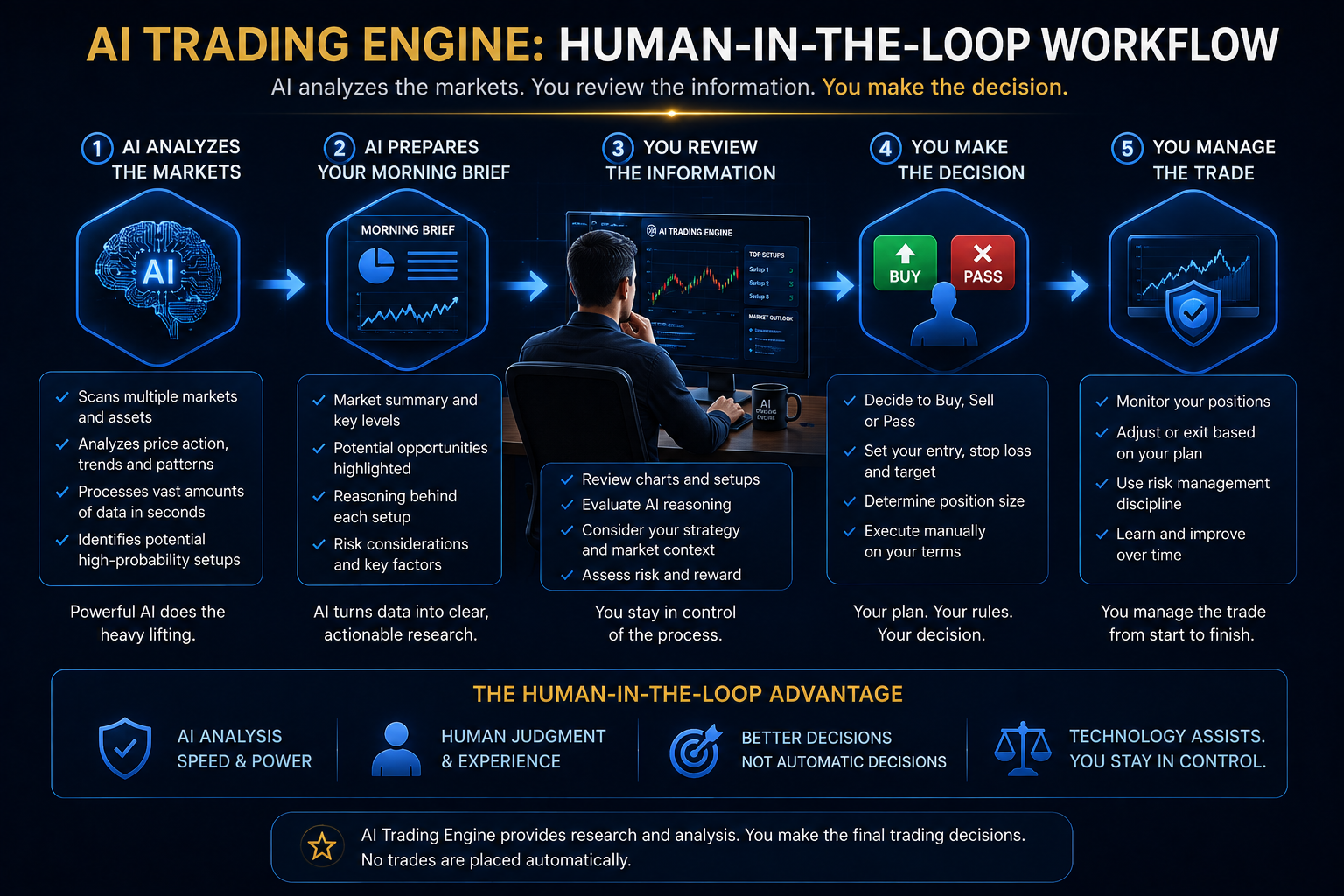
According to the product's official materials, AI Trading Engine is designed to use AI-assisted analysis rather than automatically placing trades.
The vendor describes an environment in which AI analyzes market information and prepares research for the user.
The user reviews that information and makes the final trading decision.
In other words:
The vendor explicitly states that the system does not place trades automatically.
This makes it an example of the human-in-the-loop model discussed earlier in this article.
Norzion has a separate detailed review covering the system, its Wayland environment, five-day live training, $47 front-end offer, optional upgrades, advantages, limitations, and vendor-reported claims.
Considering AI-Assisted Trading?
Read our full AI Trading Engine review for a closer look at how Sean Donahoe's system works, what the $47 offer includes, its limitations, and who it may be suitable for.
Read the AI Trading Engine ReviewWhich Approach Gives You More Control?
Generally, AI-assisted decision-support systems keep more direct control with the trader because the user remains responsible for executing the trade.
Automated bots delegate more of the execution process to software.
Neither approach is universally better.
The appropriate level of automation depends on factors such as:
- Experience
- Strategy
- Risk tolerance
- Technical knowledge
- Desired level of control
- Ability to monitor the system
Some traders prefer automation.
Others prefer receiving analytical assistance while retaining final control.
Which Is Better for Beginners?
There is no universal answer.
A beginner may appreciate structured analysis, but trading itself involves significant financial risk regardless of the technology being used.
Automation can appear simpler because software performs more tasks, but that does not mean the underlying strategy is easier to understand.
In fact, using automated systems without understanding how they make decisions can introduce additional risk.
Beginners should understand the basic mechanics of trading, position sizing, losses, and risk management before relying heavily on either AI or automation.
Practice environments and paper trading can be useful for learning how a system behaves without immediately putting real capital at risk.
Questions to Ask Before Using Any AI Trading Tool or Bot
Before choosing a platform, consider asking:
- 1.Does the software execute trades or only provide analysis?
- 2.Can I understand why it generates a particular signal?
- 3.What data does the system use?
- 4.Can I control position sizing and risk?
- 5.Are there recurring costs?
- 6.Does it require additional software or subscriptions?
- 7.Can I practice before using real money?
- 8.Are performance claims independently verified or supplied by the vendor?
- 9.What happens if the software, internet connection, or data feed fails?
- 10.Can I stop or override the system immediately?
These questions often reveal more than marketing terminology such as "AI-powered" or "fully automated."
AI Does Not Eliminate Trading Risk
Regardless of whether a trader uses artificial intelligence, algorithms, automation, or manual analysis, financial markets remain uncertain.
No software can guarantee profitable trades.
Past performance does not guarantee future results.
Backtests and historical simulations also have limitations and may not reflect real-world execution, fees, slippage, liquidity, or future market conditions.
Technology should therefore be evaluated as a tool rather than as a guarantee of financial results.
Final Thoughts
AI-assisted trading and automated trading bots can both reduce the amount of manual work involved in analyzing markets, but they do so in different ways.
AI-assisted systems can function as analytical partners, helping traders process information and identify potential setups while keeping the final decision in human hands.
Automated bots can go further by executing predefined actions when specific conditions are met.
The most important question is not simply whether a platform uses AI.
It is how much control the software has over the actual trading decision.
Understanding that distinction makes it easier to evaluate trading technology realistically — without assuming that artificial intelligence automatically means autonomous trading or guaranteed results.
Frequently Asked Questions
Is AI trading the same as automated trading?
No. AI can be used to analyze markets and support human decisions without executing trades. Automated trading refers to software that can perform trading actions automatically according to configured rules or conditions.
Can AI trading software place trades automatically?
Some platforms may combine AI analysis with automated execution, while others are designed only for research and decision support. The level of automation depends on the specific system.
Are automated trading bots profitable?
Profitability is not guaranteed. Results depend on the strategy, market conditions, execution, fees, risk management, and many other factors. Automation does not eliminate trading risk.
Does AI Trading Engine automatically trade for you?
According to the vendor's official materials, no. AI Trading Engine analyzes market information and prepares research, while the user remains responsible for the final trading decision.
Can beginners use AI trading tools?
They can, but beginners should first understand trading fundamentals and risk management. Using AI or automation does not remove the possibility of financial loss.
What is human-in-the-loop trading?
It describes an approach where technology assists with analysis or recommendations but a human remains involved in the final decision or execution process.